
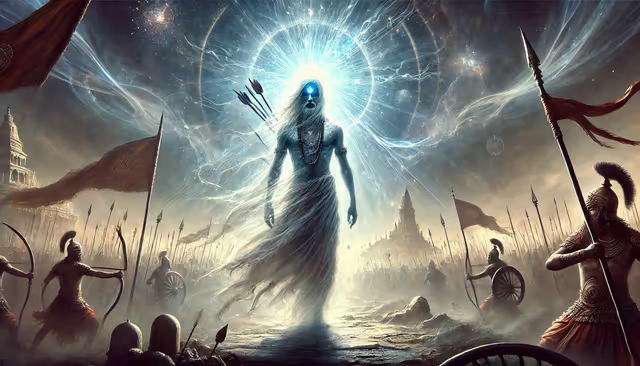
“What you do echoes. Not just in this life—through all lives. Ashwatthama still walks, still bleeds, still cannot die. He is the living proof that actions do not end when the action ends. He is karma made visible.” — Mahabharata Teaching
The One Who Cannot Die, Cannot Be Healed
Among the seven Chiranjivis, only one is cursed rather than blessed.
While Hanuman flies in joyful service and Vibhishana rules Lanka in dharma, Ashwatthama wanders the Earth wounded, alone, unable to die, unable to heal.
He is not a role model. He is a warning.
Ashwatthama was one of the greatest warriors of the Mahabharata—son of Dronacharya, master of celestial weapons, born with a jewel embedded in his forehead that made him immune to hunger, fatigue, and most forms of harm.
But in his grief and rage after the war, he committed an atrocity so profound that Krishna himself pronounced the sentence: “You will wander until the end of the age, alone, your wounds never healing, unable to find rest or death.”
Why is this man—this suffering, cursed being—considered a Chiranjivi, an “immortal”?
Because what he represents in consciousness can never die. The awareness that actions have eternal consequences—that what we do echoes through time—this is itself immortal. And sometimes, the teaching comes not through reward but through warning.
Ashwatthama as Karma-Phal (The Fruit of Action)
- Karma-Phal (कर्म-फल) philosophy
-
Karma (action) + Phal (fruit, consequence). The result or consequence of actions. In Hindu philosophy, every action (karma) produces results (phal) that eventually return to the actor—sometimes immediately, sometimes across lifetimes. Ashwatthama embodies this principle: the dimension of consciousness that knows actions echo eternally.
Ashwatthama is not a person to worship—he is a dimension of consciousness to understand.
He represents:
- The awareness that actions have consequences beyond the moment
- The visceral understanding that some choices cannot be undone
- The karmic echo that continues even when the action stops
This dimension is “immortal” not because it brings joy, but because it is inescapable. You cannot kill the principle of cause and effect. You cannot escape the physics of moral action.
Ashwatthama does not warn us because he chose to. He warns us because he IS the warning—the living testimony that what we do never truly ends. His suffering is not punishment but physics: certain causes produce certain effects.
The Myth: From Warrior to Wanderer
The Context: The Mahabharata War
The Mahabharata war had ended. The Kauravas were destroyed. Duryodhana lay dying, his thighs shattered by Bhima’s mace.
Ashwatthama had fought on the Kaurava side—not because he believed in their cause, but because his father Dronacharya had been the family teacher, and obligation bound him.
He had lost everything:
- His father Drona, killed through deception
- His king Duryodhana, dying before his eyes
- His side, utterly destroyed
- His purpose, annihilated
Only rage remained.
The Night Attack
What happened next shocked even those battle-hardened warriors:
On the night after the war ended, Ashwatthama entered the Pandava camp. Not to fight warriors—they were with Krishna. He found only sleeping men: the sons of the Pandavas, sleeping children, defenseless.
And he killed them all.
He used the Narayanastra and the Brahmastra—cosmic weapons meant for cosmic enemies—against sleeping children.
When the Pandavas discovered what had happened, their grief was indescribable. Their sons—Abhimanyu’s unborn child—were dead, murdered in their sleep by someone they had considered honorable.
The Confrontation
The Pandavas tracked Ashwatthama down. In desperation, he released the Brahmastra against the unborn child in Uttara’s womb—trying to destroy the entire Pandava line.
Krishna intervened, protecting the child (who would become Parikshit), but he could not undo what Ashwatthama had done.
| Action | Dharmic Violation | Consequence |
|---|---|---|
| Attacking sleeping people | Warriors may only fight those who are awake and armed | Eternal dishonor |
| Killing children | Children are never legitimate targets | Karmic weight of multiple murders |
| Using cosmic weapons against innocents | Sacred weapons are for sacred purposes only | Loss of the gem (his power source) |
| Attacking the unborn | Ultimate violation—destroying potential life | The curse itself |
The Curse
Krishna’s judgment was precise:
“The jewel in your forehead will be taken. The wound will never heal. For 3,000 years you will wander the Earth, unable to communicate with anyone, suffering from wounds that bleed forever but never kill you. No one will help you. No medicine will work. You will carry the weight of what you have done until the end of this age.”
The gem was pried from Ashwatthama’s forehead, leaving an open wound. And he walked into the forest, beginning an eternity of solitary suffering.
The Psychology: When Actions Echo Endlessly
Modern psychology illuminates what Ashwatthama represents:
Moral Injury
Moral injury is a psychological condition that occurs when someone violates their own moral code, particularly in war. Symptoms include:
- Persistent guilt that does not respond to treatment
- Inability to forgive oneself
- Feeling permanently damaged or contaminated
- Social isolation and withdrawal
- Loss of meaning and purpose
Ashwatthama embodies moral injury taken to the extreme: An action so far beyond the pale that no reconciliation is possible. He cannot die, but he cannot live either. He exists in the twilight of actions that cannot be undone.
The Psychology of Regret
Research on regret shows that actions violating moral principles cause the most persistent, least healable forms of suffering. Unlike practical regrets (“I wish I had invested differently”), moral regrets (“I hurt someone innocent”) tend to:
- Persist despite rational processing
- Resist time-based healing
- Create identity contamination (“I am a bad person”)
- Generate rumination cycles that reinforce suffering
Ashwatthama’s unhealing wound is the perfect symbol: The bleeding that never stops, the wound that never closes—this is what moral transgression does to the psyche.
The Bystander Effect Inverted
In the bystander effect, people fail to help because they diffuse responsibility. Ashwatthama represents the opposite: concentrated responsibility that cannot be diffused.
He cannot say “Everyone was doing it.” He cannot say “It was war.” He acted alone, with full knowledge. The responsibility is entirely his—and therefore so is the consequence.
Ashwatthama Among the Chiranjivis
Understanding his unique position:
| Chiranjivi | Status | Relationship to Ashwatthama |
|---|---|---|
| Hanuman | Blessed | Hanuman’s devoted mind vs. Ashwatthama’s grief-maddened mind |
| Vyasa | Blessed | Vyasa records the teaching; Ashwatthama IS the teaching (by negative example) |
| Mahabali | Blessed | Both sacrificed, but Mahabali in dharma, Ashwatthama in adharma |
| Vibhishana | Blessed | Vibhishana chose dharma over family; Ashwatthama chose revenge over dharma |
| Kripacharya | Blessed | Both fought for Kauravas, but Kripa maintained equanimity; Ashwatthama broke |
| Parashurama | Blessed | Both wielded anger, but Parashurama for dharma; Ashwatthama for ego/revenge |
Ashwatthama’s unique function: Every system needs a negative example. Among the Chiranjivis, he shows what happens when grief overrides wisdom, when action exceeds dharma, when the warrior breaks his own code. The other six show what to do; Ashwatthama shows what not to do.
The Contrast with Parashurama
Both Parashurama and Ashwatthama were warriors who killed. But:
-
Parashurama’s anger arose from cosmic imbalance (Kshatriyas violating dharma)
-
Ashwatthama’s anger arose from personal grief (his father’s death, his side’s loss)
-
Parashurama’s targets were guilty (corrupt warriors)
-
Ashwatthama’s targets were innocent (sleeping children)
-
Parashurama’s outcome was restoration and return to peace
-
Ashwatthama’s outcome was eternal unhealing suffering
Same energy (warrior rage), opposite orientations, opposite results. This is the essential teaching.
The Eternal Wound: What Never Heals
Ashwatthama’s wound is not just physical. It is karmic—and the myth makes this visible through physical suffering.
What the Wound Represents
- Actions imprint on consciousness permanently — Some things cannot be undone
- Crossing certain lines changes you forever — There is no going back
- Time does not heal all wounds — Moral injury resists time
- Consequences are not punishment but physics — Actions produce effects naturally
The Gem and Its Loss
The jewel in Ashwatthama’s forehead represented:
- Natural invincibility — He was born protected
- Grace unearned — He had not earned this gift
- Power without wisdom — The gem gave power but not discernment
When the gem was removed, he lost the protection he had never truly owned. The wound where the gem was cannot heal because it represents what happens when grace is abused—you lose even what you never earned.
Ashwatthama's unhealing wound is not an external punishment. It is an internal reality made visible. When you cross certain lines, you wound yourself in ways that time cannot touch. The bleeding continues because the action continues to echo.
Modern Applications: The Relevance of Karma-Awareness
Before You Act
Ashwatthama’s teaching is preventive: Consider the echo before the action.
Ask:
- “What kind of person will this action make me?”
- “Can I live with this forever—not just tomorrow, but for 3,000 years?”
- “Am I acting from dharma or from wounded ego?”
- “Would I do this if I knew it would never be forgotten?”
When Grief Demands Action
Ashwatthama acted from overwhelming grief—understandable but not justified.
His teaching: Grief is real. Loss is real. But the actions taken from grief still carry consequences. The universe does not excuse adharma because we were hurting.
Practice: When grief or rage demand immediate action, invoke Ashwatthama’s image—the wandering, bleeding figure—and ask: “Am I about to create an unhealing wound?”
For Those Carrying Guilt
If you are already carrying the weight of past actions:
- Acknowledge what was done — Ashwatthama cannot hide; neither can we
- Accept the natural consequences — Not as punishment but as physics
- Recognize that the wound IS the teacher — It reminds you not to repeat
- Seek repair where possible — Unlike Ashwatthama, most actions have some path to restoration
- Do not harm yourself further — Ashwatthama’s curse is enough; don’t add your own
The Sadhana: Working with Karma-Awareness
Karma Contemplation Practice
Used to develop action-consequence awareness before making important decisions:
-
Sit quietly and settle the mind. This practice requires clarity.
-
Bring to awareness the action you are considering. See it clearly—what you would do, to whom, when.
-
Ask: “What is the echo?” Not just the immediate result, but the ripples. Who is affected? How far does this travel?
-
Ask: “What kind of person does this action create?” Every action shapes the actor. What shape does this action make?
-
Invoke Ashwatthama’s image briefly. Not to frighten yourself, but to remember: actions echo eternally.
-
Feel the weight—or lightness—of the proposed action. Does it feel like healing or wounding? Dharmic or adharmic?
-
Decide consciously. If you proceed, proceed knowing. If you withdraw, withdraw knowing.
Duration: 10-20 minutes. Use before significant choices.
The Daily Review
Each evening, briefly review:
- “What echoes did I create today?”
- “Did I act from dharma or from reaction?”
- “Is there anything I need to repair before it becomes an unhealing wound?”
Forgiveness Meditation (For Smaller Wounds)
For past actions that burden you (but are not Ashwatthama-level):
- Acknowledge what was done. Name it clearly.
- Feel the weight. Don’t avoid the guilt—feel it.
- Recognize: You cannot undo, but you can repair. What repair is possible?
- Commit to the repair. Even partial repair is valuable.
- Release the obsession, but keep the lesson. The wound can become a teacher rather than a torment.
Frequently Asked Questions
The Wound That Teaches
Somewhere, Ashwatthama still walks. The wound in his forehead still bleeds. He still cannot speak, cannot heal, cannot die.
This is not tragedy—it is teaching.
Every time you consider an action that crosses a line…
Every time grief or rage demands immediate response…
Every time you are tempted to “just this once” violate your own code…
He is there. The living evidence that actions echo eternally.
You are not Ashwatthama. You have not done what he did. But you carry the same faculty—the karma-awareness that knows, before you act, whether you are creating healing or wounding.
Will you listen to that knowing?
His wound bleeds so yours doesn’t have to.
Related explorations: The Seven Chiranjivis: Complete Guide | Hanuman: The Devoted Mind | Parashurama: Righteous Warrior Energy | Vibhishana: Dharmic Conscience
Loading conversations...