
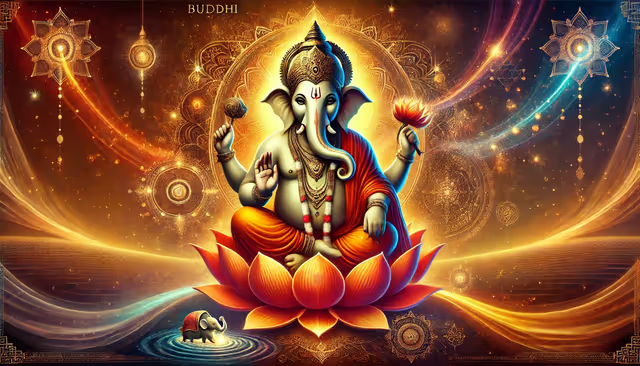
“The one who removes obstacles does not do so with force—but with intelligence. The elephant moves the mountain not by fighting it, but by knowing exactly where to step.” — Tantric Teaching
The Riddle That Defeated the Gods
There is a story in the Puranas that all spiritual seekers should know.
Once, the gods were challenged to a race: whoever could circumnavigate the universe first would be declared the wisest. Kartikeya, Shiva’s athletic son, immediately mounted his peacock and shot off into space, determined to circle every star, every galaxy, every dimension.
Ganesha, the elephant-headed one, simply smiled.
He walked slowly around his divine parents—Shiva and Parvati—and sat back down.
“What are you doing?” asked the confused assembly.
“My parents ARE the universe,” Ganesha replied. “Shiva is pure consciousness. Parvati is all energy and matter. Together, they are everything. I have circumnavigated the cosmos.”
Ganesha won.
This is Buddhi in action. Not the intellect that accumulates facts or wins arguments—but the penetrating wisdom that perceives the essence of things directly. The intelligence that solves problems before they become problems. The discernment that sees through complexity to underlying simplicity.
And this is why, in the map of the Antahkarana (the inner instrument of consciousness), Lord Ganesha represents Buddhi—the highest faculty of the human mind.
What Is Buddhi, Really?
Most translations render Buddhi as “intellect” or “intelligence.” But this is like calling the sun “a light source.” Technically accurate, profoundly inadequate.
- Buddhi (बुद्धि) philosophy
-
From the Sanskrit root budh—“to awaken,” “to perceive,” “to know.” Buddhi is not mere thinking (that’s Manas); it is awakened intelligence—the faculty that discerns real from unreal, lasting from passing, self from not-self. It is the “decider” consciousness that determines what is true.
In Samkhya philosophy, Buddhi is the first evolute of Prakriti—the very first thing that emerges from undifferentiated consciousness. Before ego (Ahamkara), before mind (Manas), before sense organs—Buddhi comes first.
This is significant: it means Buddhi is the closest faculty to pure consciousness itself. It is the bridge between the transcendent Self (Atman/Purusha) and the manifest personality you call “me.”
Ganesha sits at this bridge. He is the guardian and embodiment of the faculty that connects you to your deepest nature.
Manas asks questions. Buddhi knows answers. Manas sees multiplicity. Buddhi perceives unity. Manas doubts. Buddhi discerns.
Why an Elephant Head? The Neurological Symbolism
The ancient seers chose the elephant with precision. Every element of Ganesha’s form encodes teachings about the nature of awakened intelligence.
The Massive Head: Capacity for Wisdom
The elephant has the largest brain of any land animal. Ganesha’s enormous head symbolizes:
- Vast capacity for knowledge and insight
- Deep contemplation rather than quick reaction
- The weight of wisdom—true understanding is substantial, not light
The Large Ears: Deep Listening
Elephants communicate across miles using infrasound—frequencies below human hearing. Ganesha’s massive ears represent:
- Shravanam—the practice of sacred listening
- Hearing what others miss—the subtle truths beneath surface noise
- Receptivity to teaching and higher guidance
The Small Eyes: Focused Attention
Compared to the ears and head, Ganesha’s eyes are notably small. This represents:
- Focused concentration rather than scattered attention
- Seeing essence rather than being distracted by appearances
- The power of single-pointed awareness (ekagrata)
The Trunk: Precision and Adaptability
An elephant’s trunk contains over 40,000 muscles, capable of both uprooting trees and picking up single blades of grass. This symbolizes:
- Discrimination (Viveka)—the ability to distinguish subtle differences
- Adaptability—adjusting approach based on situation
- The power to both grasp and let go
- Viveka (विवेक) concept
-
The discriminating wisdom that distinguishes real from unreal, permanent from impermanent, Self from not-self. This is Buddhi’s essential function—and Ganesha’s trunk in action.
The Broken Tusk: Sacrifice for Truth
One legend says Ganesha broke his own tusk to write the Mahabharata as Vyasa dictated. This represents:
- Sacrifice for knowledge—wisdom has a price
- Commitment to truth over personal comfort
- The willingness to be incomplete in the eyes of the world for the sake of something greater
The Mouse Vehicle: Mastery Over the Mind
The tiny mouse (Mushika) as Ganesha’s vehicle is perhaps the most psychologically profound symbol:
- The mouse represents Manas—the restless, nibbling mind that gnaws at everything
- Ganesha rides the mouse, not fights it—Buddhi directs but doesn’t destroy the mind
- The enormous elephant balanced on the tiny mouse shows that wisdom can govern even the most agitated mental states
| Symbol | Represents | Buddhi Function |
|---|---|---|
| Large Head | Vast capacity for wisdom | Container for knowledge and discernment |
| Big Ears | Deep listening | Receiving subtle truths, learning from teachers |
| Small Eyes | Focused attention | Concentration, seeing essence |
| Trunk | Precision and adaptability | Discrimination (Viveka), wise action |
| Broken Tusk | Sacrifice for truth | Commitment to wisdom over comfort |
| Big Belly | Digesting all experience | Equanimity, processing life’s inputs |
| Mouse Vehicle | The restless mind | Directing and riding mental energy, not crushing it |
Vighnaharta: The Real Nature of Obstacle Removal
Ganesha’s most famous title is Vighnaharta (विघ्नहर्ता)—“Remover of Obstacles.” But what does this actually mean?
- Vighnaharta (विघ्नहर्ता) term
-
From Vighna (obstacle) and Harta (remover/destroyer). Ganesha is invoked before any important undertaking—not for magical protection, but to invoke the quality of awakened intelligence that perceives and resolves problems.
Most people pray to Ganesha hoping he’ll remove external obstacles—difficult bosses, financial problems, health challenges. There’s nothing wrong with this, but it misses the deeper teaching.
The real obstacles Ganesha removes are internal:
Obstacle 1: Ignorance (Avidya)
The fundamental obstacle—not knowing your true nature. Buddhi is the faculty that perceives truth directly, cutting through the confusion of thoughts and beliefs to direct knowing.
Obstacle 2: Ego Inflation (Asmita)
The sense “I am this limited body-mind” blocks recognition of limitless awareness. Ganesha’s humility—despite his cosmic status—models how Buddhi functions without ego.
Obstacle 3: Attachment (Raga)
Clinging to pleasure creates suffering. Buddhi enables Vairagya (dispassion)—the ability to enjoy without grasping.
Obstacle 4: Aversion (Dvesha)
Running from pain creates more suffering. Buddhi allows direct seeing of experience without reactive avoidance.
Obstacle 5: Fear of Death/Change (Abhinivesha)
The deepest obstacle. Buddhi perceives the eternal Self beyond all change, relieving the fear that underlies all other fears.
Ganesha doesn't fight obstacles—he dissolves them through seeing clearly. When you truly understand a problem, it often ceases to be a problem. This is the secret of obstacle removal.
The Neuroscience of Wisdom: How Buddhi Works in the Brain
Modern neuroscience is beginning to map what the ancients intuited about the wisdom faculty.
The Prefrontal Cortex: The Seat of Buddhi?
The prefrontal cortex (PFC), located behind the forehead, handles:
- Decision-making and judgment
- Long-term planning (seeing consequences)
- Impulse regulation (overriding reactive behavior)
- Abstract thinking (perceiving patterns and principles)
- Self-awareness (the meta-cognitive observer)
This is remarkably close to the traditional description of Buddhi. The PFC is literally the physiological correlate of discriminating wisdom.
Why the PFC/Buddhi Can Be “Hijacked”
When we’re stressed, the amygdala (fear center) can override the prefrontal cortex. This is why wise people sometimes act foolishly under duress—Buddhi is temporarily offline.
Ganesha’s calm demeanor represents the state where Buddhi remains sovereign even under pressure. His equanimous smile is the face of a nervous system in which wisdom is not overwhelmed by fear.
Meditation Strengthens Buddhi
Research shows that meditation practice literally increases grey matter density in the prefrontal cortex while reducing amygdala reactivity. Meditation is Buddhi training.
This is why Ganesha is invoked before spiritual practice—you are calling upon the faculty of discernment that meditation itself develops.
Buddhi vs. Manas: The Critical Distinction
One of the most practically important teachings in Hindu psychology is the difference between Manas (mind) and Buddhi (wisdom).
| Manas (Mind) | Buddhi (Wisdom) |
|---|---|
| Questions and doubts | Discerns and decides |
| Sees problems | Sees solutions |
| Reactive | Responsive |
| Scattered | Focused |
| Moves in circles | Moves toward truth |
| Attached to outcomes | Sees clearly regardless of preference |
| Influenced by emotions | Observes emotions with equanimity |
Manas is represented by Hanuman—the devoted, powerful, but sometimes impulsive servant.
Buddhi is represented by Ganesha—the calm, discerning lord who directs the energy of mind.
The spiritual path involves training Manas to serve Buddhi rather than the other way around. Most human suffering comes from Manas running the show—endless mental chatter, reactive decisions, identification with passing thoughts and emotions.
When Buddhi leads, you think clearly, decide wisely, and remain stable regardless of external circumstances.
The Four Powers of Awakened Buddhi
When Buddhi is fully developed, four capabilities emerge:
1. Dharana: The Power of Concentration
- Dharana (धारणा) practice
-
The ability to hold awareness steady on a single point or object. This is the foundation of all meditation and mental mastery.
Ganesha’s small, focused eyes represent this power. A scattered mind sees everything but understands nothing. A concentrated mind penetrates to essence.
2. Viveka: The Power of Discrimination
- Viveka (विवेक) practice
-
The capacity to distinguish between the real and the unreal, the permanent and the transient, the Self and the not-self. This is Buddhi’s highest function.
Ganesha’s trunk—capable of both grasping and releasing, both force and delicacy—represents this discriminating power. Jnana Yoga (the path of knowledge) is essentially the cultivation of Viveka.
3. Vairagya: The Power of Dispassion
- Vairagya (वैराग्य) practice
-
Non-attachment to outcomes. Not cold indifference, but freedom from the compulsive grip of desire and fear. The ability to act wisely without being driven by craving.
Ganesha’s serene expression, despite his cosmic power and knowledge, represents Vairagya. He could desire anything—and chooses peace.
4. Shama: The Power of Mental Calm
- Shama (शम) practice
-
Inner tranquility that persists regardless of external conditions. Not suppression of activity, but stability that underlies all activity.
Ganesha’s steady seated posture represents Shama—the unshakeable ground from which all wise action arises.
Developing Buddhi: Practical Techniques
Awakened Buddhi doesn’t happen automatically. Like any faculty, it must be trained.
1. Self-Inquiry (Atma Vichara)
The most direct method. Continuously ask: “Who am I?” or “What is aware of this thought/sensation/experience?”
This inquiry naturally activates Buddhi—you’re asking Buddhi to examine its own source.
Practice: Before making any significant decision, pause and ask: “Who is about to decide? What would my wisest self do here?“
2. Study of Sacred Texts (Svadhyaya)
Reading scripture isn’t about collecting information—it’s about letting the words of the wise resonate with your own Buddhi, awakening what is already there.
Practice: Read one verse from the Bhagavad Gita, Vivekachudamani, or Upanishads daily. Don’t analyze excessively—let the teaching work on you.
3. Meditation (Dhyana)
Regular meditation increases prefrontal cortex activity and reduces amygdala hijacking. This is direct Buddhi training.
Practice: 20 minutes daily of any concentration technique—breath awareness, mantra, or Raja Yoga practices.
4. Discernment Practice
Throughout the day, practice distinguishing:
- Reaction vs. response
- Emotion vs. the awareness of emotion
- Thought vs. the space in which thought arises
- Noise vs. signal in any situation
Practice: When upset, pause and ask: “What is the unchanging awareness that is noticing this upset?” This single question activates Buddhi.
5. Sat-Sanga (Wise Company)
Buddhi is contagious. Time spent with wise people or in wise environments naturally elevates your own discernment.
Practice: Curate your inputs. Reduce time with chaotic or negative influences. Increase time with teaching, teachers, and fellow seekers.
6. Ganesha Mantra Practice
The traditional method—invoking the lord of Buddhi directly.
Main Mantra:
ॐ गं गणपतये नमः“Om Gam Ganapataye Namah”
Buddhi-Specific Mantra:
ॐ बुद्धिं देहि बुद्धि भद्रां“Om Buddhim Dehi Buddhi Bhadram” (“Grant wisdom, grant auspicious wisdom”)
Practice: 108 repetitions daily, ideally at dawn or before study/important decisions.
Ganesha at the Start: Why He’s Invoked First
In Hindu tradition, Ganesha is always worshipped before beginning any undertaking. Before weddings, businesses, journeys, rituals—Ganesha comes first.
Why?
Because Buddhi must be engaged before action for that action to succeed. Random activity without discernment creates chaos. Considered action guided by wisdom creates desired outcomes.
By invoking Ganesha, you are essentially saying: “Let me approach this with awakened intelligence, not blind reaction.”
The Integration: Living as Ganesha
The ultimate teaching isn’t about worshipping Ganesha as external deity—it’s about becoming Ganesha, embodying awakened Buddhi in daily life.
This means:
- Thinking before reacting — the pause where wisdom lives
- Listening deeply before responding — the big ears
- Focusing on essence rather than noise — the small eyes
- Adapting your approach to the situation — the flexible trunk
- Directing mental energy rather than being hijacked by it — riding the mouse
- Remaining calm amidst chaos — the steady seat
- Using intelligence to serve, not dominate — Ganesha’s humility
When you live this way, you don’t need external obstacle removal—you are the obstacle remover. Problems dissolve in the light of clear seeing. Confusion gives way to insight. Reactivity yields to wise response.
This is Buddhi as Lord Ganesha. This is the elephant-headed god as your own awakened intelligence.
Frequently Asked Questions
The Eye of Wisdom Opens
There is a teaching from the Yoga Sutras: “Tada drashtuh svarupe avasthanam”—When fluctuations cease, the Seer abides in its own nature.
This is the state where Buddhi is pure—undistorted by emotional reaction, unclouded by mental noise. In this clarity, the Self recognizes itself.
Ganesha’s calm gaze represents this state. The elephant-headed god, seated in perfect stability, is the image of awakened Buddhi—the intelligence that has ceased being hijacked by lesser impulses and now sees reality directly.
This is not a mythological fantasy. It is your own potential. The capacity for wisdom is built into human consciousness. It merely needs to be developed, strengthened, and allowed to lead.
Every time you invoke Ganesha, every time you pause before reacting, every time you ask “What is the wise view here?”—you are exercising this faculty. You are becoming more of what you already are.
The elephant-headed god is not just outside, on an altar, in a story.
He is inside, waiting to be awakened.
Related explorations: Manas as Hanuman: Mastery of Mind | Jnana Yoga: The Path of Knowledge | Vivekachudamani: The Crest-Jewel of Discrimination | Meditation for Beginners | The Antahkarana Explained
Loading conversations...