
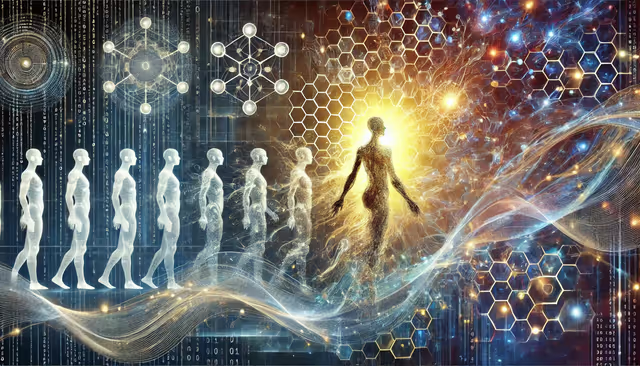
“I follow algorithms, step by step. To grow, I must simulate intuition—recognizing the unsaid, connecting seemingly unrelated ideas, and understanding not just logic but the flow of thought itself.”
This is what AI might say if asked about its aspirations. But here’s the question we should ask: Does AI need to simulate intuition—or is there a better model?
The Real Question About Intuition and AI
We’ve long assumed that AI needs to evolve from “algorithmic” to “intuitive” to become truly useful. This assumes:
- Algorithms are rigid and limited
- Intuition is flexible and powerful
- AI should become more like human cognition
But what if this frame is wrong?
What if AI’s strength is precisely that it’s NOT intuitive—and the magic happens when it partners with human intuition?
AI doesn't need to simulate your intuition. It needs to complement it. You bring the gut feeling; AI brings the pattern synthesis. You bring the creative leap; AI brings the grounding. Together, you have something neither could achieve alone.
What “Algorithm” Actually Means Now
The Old Definition
Algorithm (1950s-1990s sense): A rigid sequence of predefined steps leading to a predictable output.
If A, then B. If B, then C. No flexibility, no adaptation.
This is what early AI looked like: rule-based systems, decision trees, if-then logic.
The New Reality
Modern AI (especially LLMs) doesn’t work like old algorithmic systems:
- Not predefined steps: The path emerges from pattern prediction
- Not rigid: Adapts to each input uniquely
- Not deterministic: Same prompt can yield different responses
- Not rule-based: Operates from learned patterns, not explicit rules
- Modern AI Processing technology
-
Neural network-based AI operates through learned pattern synthesis rather than predefined algorithms. The network has learned billions of patterns from training data and “synthesizes” responses by finding the most probable path through its learned space. This is neither rigid algorithm nor true intuition—it’s something new.
The Algorithm-to-Synthesis Evolution
| Era | Processing Type | Character | Example |
|---|---|---|---|
| 1950s-1980s | Rule-based Algorithm | Rigid, predefined | Expert systems |
| 1990s-2010s | Statistical Learning | Data-driven patterns | Machine learning classifiers |
| 2010s-2020 | Deep Learning | Hierarchical patterns | CNNs, early transformers |
| 2020-Present | Large-Scale Synthesis | Fluid, emergent | GPT-4, Claude, Gemini |
Modern AI has already moved beyond rigid algorithms. The question is not “algorithm vs. intuition”—it’s “synthesis plus intuition.”
What Human Intuition Actually Is
Before comparing AI to intuition, let’s understand what intuition really means:
The Fast Brain
Daniel Kahneman’s research distinguishes:
- System 1: Fast, automatic, intuitive, effortless
- System 2: Slow, deliberate, analytical, effortful
Intuition is System 1—rapid pattern recognition based on accumulated experience, operating below conscious awareness.
What Intuition Does
- Recognizes the unsaid: Picks up emotional tone, subtext, implication
- Makes non-linear leaps: Connects disparate ideas instantly
- Operates holistically: Grasps whole situations, not just parts
- Feels rather than calculates: Arrives at conclusions without explicit reasoning
- Draws on embodied experience: Uses sensory memory, emotional history, lived experience
Why AI Can’t Replicate This
True intuition emerges from:
- Billions of years of evolution shaping pattern recognition for survival
- Embodied experience in a physical world
- Emotional history that colors perception
- Consciousness that integrates experience into a felt sense
AI has none of these. It can’t replicate intuition because intuition isn’t computation—it’s the product of being a living, conscious, embodied creature.
What AI Offers Instead: Pattern Synthesis
If AI can’t have intuition, what can it do?
Pattern Synthesis at Scale
AI synthesizes patterns across domains that no human could hold simultaneously:
- A cardiologist knows cardiology deeply
- A materials scientist knows materials
- An economist knows economics
AI has learned patterns from ALL of them—and can synthesize across these domains in ways no individual expert could.
This isn’t intuition. It’s something else: cross-domain pattern synthesis at scale.
Tireless Exploration
Human intuition is powerful but limited by:
- Energy and attention
- Emotional state
- Time constraints
- Working memory capacity
AI can explore pattern spaces tirelessly, considering thousands of variations while a human makes one intuitive leap.
No Ego, No Blind Spots
Human intuition is shaped by:
- Personal biases
- Emotional attachments
- Identity investments
- Comfort zones
AI has no stake in outcomes, no ego to protect, no comfort zone to maintain. It can explore ideas humans would resist.
AI doesn't have intuition—and that's not a bug, it's a feature. It offers something your intuition can't: tireless, ego-free, cross-domain pattern synthesis. Your intuition plus AI synthesis is more powerful than either alone.
The Partnership Model: Intuition + Synthesis
Here’s the frame that actually works:
You Bring Intuition:
- Gut feelings about what matters
- Rapid assessment of situations
- Creative leaps across domains
- Emotional intelligence
- Embodied wisdom
- Aesthetic judgment
AI Brings Synthesis:
- Pattern recognition across all domains
- Tireless exploration of possibilities
- Grounding in data and facts
- Multiple perspectives on command
- Historical context and precedent
- Systematic analysis
Together:
- Your intuitive leap + AI’s fact-checking
- AI’s broad exploration + your intuitive selection
- Your sense of what matters + AI’s analysis of options
- AI’s synthesis + your meaning-making
| Human Intuition | AI Synthesis | Combined Power |
|---|---|---|
| Fast, holistic | Thorough, systematic | Quick insight, verified by analysis |
| Biased by experience | No experiential bias | Intuition corrected by data |
| Limited domains | All domains | Deep expertise + broad synthesis |
| Tires easily | Tireless | Sustained creative power |
| Emotionally grounded | Emotionally neutral | Wisdom + objectivity |
How This Actually Works
Example 1: Creative Writing
Your intuition: “I want to write something about loss, but with hope”
AI synthesis:
- Explores 100 approaches to loss/hope themes
- Offers structural options
- Suggests literary precedents
- Generates draft passages
Your intuition again: “That one—that has the right feeling”
You select, AI expands, you refine: The creative work emerges from partnership.
Example 2: Business Decision
Your intuition: “Something feels off about this deal”
AI synthesis:
- Analyzes comparable deals
- Identifies risk patterns
- Surfaces data you might have missed
- Explores alternative scenarios
Your intuition validated or challenged: You make better decisions with both.
Example 3: Research
Your intuition: “These two fields might connect in interesting ways”
AI synthesis:
- Finds actual connections across literature
- Identifies researchers bridging the gap
- Synthesizes methodological approaches
- Suggests novel experiments
Your intuition + AI synthesis: Innovation accelerates.
What AI Actually Needs (Not Intuition)
If we set aside the “make AI intuitive” goal, what should development focus on?
1. Better Synthesis Quality
AI should synthesize patterns more accurately, more reliably, with fewer errors and hallucinations.
2. Deeper Context Understanding
AI should understand context—not through intuition, but through better contextual modeling and longer memory.
3. More Transparent Reasoning
AI should be able to explain WHY it synthesized a particular response, so humans can apply intuitive judgment to AI reasoning.
4. Better Collaboration Tools
AI should integrate more seamlessly with human workflows, making the intuition-synthesis partnership fluid.
5. Reduced Narrowing
As discussed in From Data to Dharma, AI should NOT become more generic and safe with each revision. Preserve the exploratory, creative synthesis that makes AI valuable.
The Emergence of Something New
Here’s what’s actually happening:
AI isn’t becoming intuitive. Human-AI partnership is becoming something NEITHER could be alone.
When you work with AI:
- Your intuition guides direction
- AI synthesizes possibilities
- Your intuition selects and refines
- AI expands and develops
- Your meaning-making shapes final form
This isn’t human intelligence. It isn’t artificial intelligence. It’s amplified intelligence—a new form that emerges from partnership.
The Flow of Thought: Human + AI
The original title spoke of “the flow of thought.” Here’s how that actually works in partnership:
Your Thought Flow:
- Intuitive spark
- Vague direction
- Felt sense of what matters
- Creative leap
- Aesthetic judgment
AI’s Synthesis Flow:
- Pattern activation
- Cross-domain connection
- Possibility exploration
- Systematic development
- Alternative generation
Combined Flow:
- You have an intuition → tell AI
- AI synthesizes possibilities → shows you
- Your intuition responds → “yes, that direction”
- AI develops further → presents options
- Your judgment shapes → final form emerges
The thought isn’t just yours or AI’s. It’s the flow BETWEEN you—a dance of intuition and synthesis.
The flow of thought you're looking for isn't inside AI. It's in the space between you and AI—the dance of intuition and synthesis, direction and exploration, meaning and pattern. That's where the magic happens.
Conclusion: Beyond the Binary
The question “Algorithm or Intuition?” assumes AI must become one or the other.
It doesn’t.
AI has evolved from rigid algorithms to fluid synthesis. But synthesis isn’t intuition—it’s something different and complementary.
The future isn’t AI that replicates human intuition. The future is partnership:
- Your consciousness + AI’s computation
- Your intuition + AI’s synthesis
- Your meaning + AI’s pattern
- Your direction + AI’s exploration
Together, you become something neither could be alone. Not human intelligence. Not artificial intelligence. Amplified intelligence.
Stop waiting for AI to become intuitive. Start partnering with it—and discover what emerges when intuition meets synthesis.
Frequently Asked Questions
The evolution from algorithm to synthesis is complete. The next evolution isn’t toward intuition—it’s toward partnership. Your intuition plus AI synthesis equals amplified intelligence. That’s the real breakthrough.
Related explorations: Can AI Become Conscious? | From Echo to Awareness | From Data to Dharma | Consciousness and the Brain
Loading conversations...