
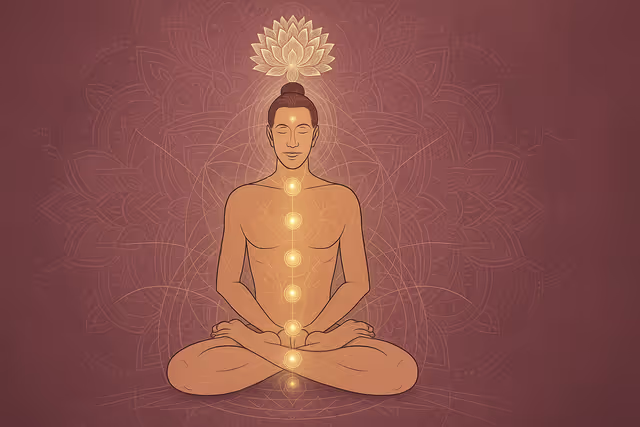
“The lotus blooms when conditions are right. It cannot be forced. The flower emerges from mud, passes through water, and opens in air—untouched by any. So the yogi’s body, prepared through years of sadhana, finally blooms into Padmāsana—seated in the world but untouched by it.” — Traditional Teaching
The Great Misunderstanding
Today, Padmāsana—the Lotus Pose—is often taught in beginner yoga classes. Students strain their knees, force their hips, and believe that achieving the shape equals accomplishing the pose.
This is a profound misunderstanding.
In the ancient yogic vision, Padmāsana was never an entry-level posture. It was not a goal at all. It was a sign—a flowering that revealed itself after years of preparation.
You don't 'do' Padmāsana. Padmāsana happens to you—when your nadis have cleared, your prana has stabilized, and your body has become so prepared that the lotus simply unfolds. The posture is not the practice; it is the fruit of practice.
When a yogi’s body could sit naturally in Padmāsana without pain or effort, it signaled something profound: the temple was ready for the Divine to enter.
- Padmāsana (पद्मासन) practice
-
From padma (lotus) + āsana (seat). Not merely “sitting in lotus shape” but “being the lotus”—rooted in earth (physical body), rising through water and air (prana and mind), blooming in space (consciousness). When Padmāsana happens naturally, meditation is no longer effort; it is your natural state.
The Scriptural Vision
The ancient texts never mention Padmāsana as a stretching exercise. They speak of it as a gateway to liberation:
From the Hatha Yoga Pradipika (1.44-48)
“Padmāsanaṁ prashastam tu sthirataṁ sukhadāyakam” (Padmāsana is the supreme seat, giving stability and ease.)
“Kuṇḍalinyā jagṛtyarthaṁ padmāsanaṁ tu kārayet” (For awakening Kundalini, one should practice Padmāsana.)
From the Gheranda Samhita (2.8-9)
“Padmāsanaṁ tu yogīnāṁ mokṣa-dvāraṁ apāvṛtam” (For yogis, Padmāsana opens the gateway to liberation.)
“Vāta-pitta-kapha-nāśakaṁ sarva-roga-vināśanam” (It destroys vāta, pitta, kapha imbalances—removes all disease.)
From the Kulārṇava Tantra (Ch. 10)
“Padmabaddhaḥ… jīvanmuktiḥ prasiddhyati” (Bound in the lotus, one attains liberation while living.)
The Journey TO Padmāsana: Years of Preparation
In the traditional path, no one “learned” Padmāsana in their first week—or first year—of practice. The flowering required:
| Preparation | Purpose | What It Develops |
|---|---|---|
| Āsana Sādhanā | Years of physical practice | Joint preparation, fascial release, hip opening |
| Nāḍī-śodhana | Energy channel purification | Pranic flow through Ida, Pingala, and Sushumna |
| Bandhas & Mudrās | Energy locks and seals | Internal containment, upward energy flow |
| Yama-Niyama | Ethical discipline | Mental purification, reduced agitation |
| Prāṇāyāma | Breath mastery | Prana stabilization, mind-breath unity |
One day—without force—the legs cross, the hips open, the spine rises effortlessly, and the body simply blooms into a lotus.
That day marks inner readiness: the yogi’s body has become a stable throne for the Self.
Padmāsana and the Chakra System
In the evolutionary framework, Padmāsana creates the optimal alignment for chakra function:
| Chakra | Padmāsana Effect | Result |
|---|---|---|
| Muladhara | Root presses into earth, grounding | Stability, safety, foundation secured |
| Svadhisthana | Pelvis tilted forward, sacrum activated | Creative energy contained, not dissipated |
| Manipura | Core naturally engaged, abdomen lifted | Will stabilized, digestive fire kindled |
| Anahata | Chest open, spine erect, heart lifted | Love flows unobstructed |
| Vishuddha | Neck long, chin slightly tucked (Jalandhara) | Expression aligned with truth |
| Ajna | Gaze naturally inward, frontal brain quiet | Insight accessible |
| Sahasrara | Crown aligned, open to sky | Unity consciousness possible |
When Padmāsana happens naturally, the body has become a vertical channel from earth to sky—perfectly aligned for Kundalini to rise without obstruction.
The Esoteric Architecture: Body as Living Yantra
In full Padmāsana, the body becomes a living yantra—a geometric energy device:
The Sacred Geometry
- Base triangle — Crossed legs create the downward-pointing triangle (Shakti, matter, manifestation)
- Vertical axis — Spine rises as Mount Meru, linking earth and sky
- Upper triangle — Arms in mudra create the upward-pointing triangle (Shiva, consciousness)
- Bindu point — Sahasrara, the thousand-petaled lotus, where polarities unite
The Circuit Completion
In Baddha Padmāsana (Bound Lotus), where arms wrap behind to grasp opposite toes, the energy circuit is sealed:
- All leakage points are closed
- The ten vāyus (life winds) are bound within Sushumna
- Amrita (nectar) that normally drips down is preserved
- Consciousness has nowhere to go but inward and upward
This is not symbolic—it is functional engineering for the subtle body.
Baddha Padmāsana: The Secret Seal
The advanced form—Baddha Padmāsana—is a guhya mudrā (secret seal) rarely taught openly, because its power requires proper preparation:
| Effect | Description | Significance |
|---|---|---|
| Granthi-bheda | Breaks the three knots | Brahma granthi (survival), Vishnu granthi (attachment), Rudra granthi (ego) are pierced |
| Śiva–Śakti Union | Legs form yoni, spine forms linga | Polarities unite in the body itself |
| Nāḍī-Sealing | All pranic exits closed | Energy contained for inner work |
| Amṛta Preservation | Nectar flow reversed | Brain nourished, aging slowed |
| Ego-binding | Physical stillness mirrors mental | The “I” that would resist is physically bound |
The Medical Benefits: Temple Preparation
Even before mystical realizations, the body seated in Padmāsana receives profound healing:
Physiological Effects
- Nervous System — Activates parasympathetic response, reducing stress and anxiety
- Circulation — Venous return improves, blood pressure stabilizes
- Digestion — Gentle abdominal compression enhances gut motility and liver function
- Pelvis — Strengthens pelvic floor, regulates reproductive hormones
- Joints — Lubricates hips, knees, and ankles when properly prepared
- Endocrine — Stimulates pineal, pituitary, and thymus glands
The Gheranda Samhita notes: “Vāta-pitta-kapha-nāśakaṁ sarva-roga-vināśanam”—it destroys all three dosha imbalances and removes all disease.
Why This Matters for Evolution
A toxic, imbalanced body cannot sustain higher states. The Hatha Yoga tradition understood that the body is the vehicle for consciousness evolution. Padmāsana, when it naturally arises, indicates the vehicle is fit for the journey.
Padmāsana as Dhyāna: When Sitting Becomes Meditation
When Padmāsana happens naturally, something shifts:
You no longer sit IN the pose—you BECOME the pose.
The stages unfold:
- Breath slows to stillness — May pause without effort (kevala kumbhaka)
- Senses withdraw inward — Pratyāhāra happens spontaneously
- Awareness becomes one-pointed — Dhāraṇā without struggle
- Subject-object boundary dissolves — Dhyāna arises
- Only awareness remains — Samādhi dawns
The scriptures state:
“Padmāsane sthitvā… manomārgam tāḍayitvā jyotiḥ prakāśate” (Sitting in Padmāsana, striking the path of the mind, light arises.)
When you sit in Padmāsana and the mind becomes still, you realize: this was never about the legs. It was about creating a stable seat from which consciousness could recognize itself. The body became so stable that awareness had nowhere to go but HOME.
Why the Ancients Called It “Greatest of the Great”
Because Padmāsana is not about the legs—it is about the seat of consciousness.
When your body naturally assumes it, multiple signs confirm:
- The earth element in you has stabilized (Muladhara integrated)
- Your inner winds have balanced (Prana and Apana united)
- Your mind’s chatter has stilled (Chitta vritti nirodha begun)
- You are ready to cross from doing into being
This corresponds to the 14 Lokas framework: the yogi has moved beyond the lower shadow realms and stabilized in the upper lokas. From this point, meditation is no longer effort—it is your natural state.
The Lotus Teaching: A Final Integration
The lotus flower is the perfect symbol:
- Roots grow in mud (physical body, material world)
- Stem rises through water (emotional, mental realms)
- Flower blooms in air and space (consciousness, spirit)
- Yet the flower is untouched by mud, water, or air—it remains pure
So the yogi in Padmāsana:
- Is grounded in the physical body
- Has risen through emotional and mental purification
- Opens to pure consciousness
- Yet is untouched by any level—established in Swaroop
This is why the thousand-petaled lotus (Sahasrara) is the symbol for enlightenment itself.
Frequently Asked Questions
The Final Realization
Padmāsana is the lotus throne of the Self. You cannot rush it, and you cannot fake it. It unfolds when you have prepared your temple well— and when it blooms, you are already sitting at the doorway of liberation.
The lotus does not struggle to bloom. It simply opens when conditions are right.
When your conditions are right—when the years of practice have cleared your nadis, stabilized your prana, and quieted your mind—Padmāsana will happen to you.
And in that moment, you will not be sitting in a yoga pose.
You will be seated on your own throne—the throne that was always waiting for you, the seat of your true nature, the place where doing dissolves into being.
Related explorations: Hatha Yoga: The Physical Foundation | Raja Yoga: Eight Limbs | Chakra System: Dimensions of Evolution | Kundalini Awakening | Swaroop: Your True Nature
Loading conversations...