Abstract
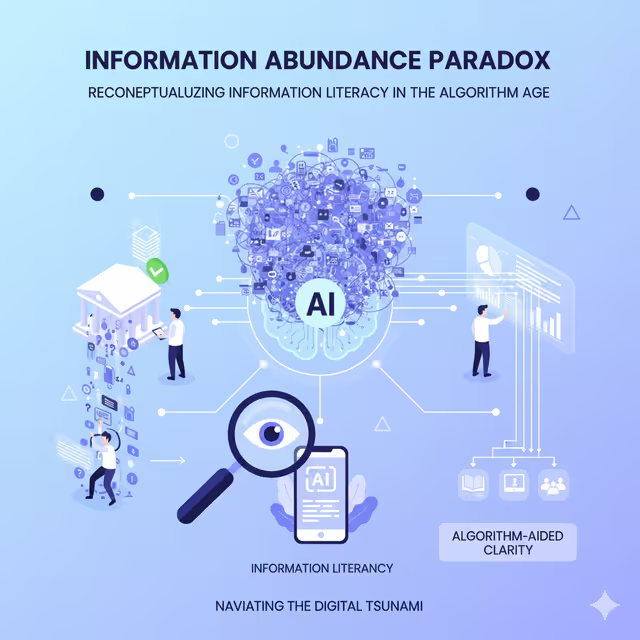
Access to information has never been greater, yet evidence on reading, source evaluation and learning suggests that access alone does not produce understanding. Herbert Simon anticipated the problem in 1971: a wealth of information creates a poverty of attention. This paper reconceptualises information literacy for environments shaped by recommendation algorithms and, increasingly, by generative AI. It proposes a two-dimensional framework. The first dimension distinguishes lateral processing (rapid movement across many sources) from vertical processing (sustained engagement that builds understanding). The second, which prior accounts neglect, distinguishes who controls the path: an external system optimised for engagement, or the learner's own goal. The framework explains an apparent contradiction in the literature, namely that lateral reading is the expert strategy of professional fact-checkers, while heavy, externally driven media multitasking is associated with poorer cognitive performance. The problem is not lateral processing but externally controlled processing. Generative AI adds a third risk, the outsourcing of vertical processing itself: in a field experiment, students given unrestricted access to GPT-4 practised more successfully but performed worse once access was removed, whereas a version designed to give hints instead of answers largely avoided the harm. The paper rejects the "digital native" premise of earlier accounts, defines cognitive mode switching as a teachable, measurable competence, and proposes six design principles and five testable propositions.
- Author
- Saket Poswal · ORCID 0009-0009-8574-9953 · Google Scholar
- Type
- Analysis (working paper, not peer reviewed)
- Published
- Last revised
- Method
- Conceptual framework development through critical narrative review of information science, cognitive psychology and educational technology research
- License
- CC BY 4.0
- Keywords
- information literacy · information abundance · attention economy · lateral reading · cognitive mode switching · algorithmic curation · generative AI and learning · desirable difficulties · digital native myth · media multitasking · civic online reasoning
Cite this paper
Poswal, S. (2025, October 1). The Information Abundance Paradox: Reconceptualizing Information Literacy in the Algorithm Age [Working paper]. saketposwal.com. https://doi.org/10.5281/zenodo.23011067
Poswal, Saket. "The Information Abundance Paradox: Reconceptualizing Information Literacy in the Algorithm Age." saketposwal.com, 1 Oct. 2025, https://doi.org/10.5281/zenodo.23011067.
Poswal, Saket. "The Information Abundance Paradox: Reconceptualizing Information Literacy in the Algorithm Age." Working paper, saketposwal.com, October 1, 2025. https://doi.org/10.5281/zenodo.23011067.
@techreport{poswal2025information,
  author = {Poswal, Saket},
  title = {{The Information Abundance Paradox: Reconceptualizing Information Literacy in the Algorithm Age}},
  year = {2025},
  month = oct,
  institution = {saketposwal.com},
  type = {Working Paper},
  url = {https://saketposwal.com/research/the-information-abundance-paradox-reconceptualizing-information-literacy-in-the-algorithm-age/},
  doi = {10.5281/zenodo.23011067},
  keywords = {information-literacy, digital-literacy, attention-economy, algorithm-literacy, generative-ai, lateral-reading}
}
Download: BibTeX (.bib) · RIS (.ris) for Zotero, Mendeley, EndNote
Working paper · Version 2.0 (29 September 2026)
Revision note. Version 2.0 substantially revises the October 2025 paper. The lateral/vertical distinction and the concept of cognitive mode switching are retained, but the framework now adds a second dimension (who controls processing) that resolves a conflict with the established literature on lateral reading. The original’s reliance on generational “digital native” claims has been removed in light of evidence against them; claims about filter bubbles and multitasking are restated to match the empirical literature; evidence on generative AI has been added; and the conclusions are restated as testable propositions.
1. Introduction
In 1971, Herbert Simon observed that “a wealth of information creates a poverty of attention” (Simon, 1971). Half a century later, his remark describes the everyday condition of learners. Search engines, social platforms and, since 2022, generative AI systems put more information within reach than any previous generation has had, yet evidence from reading research, assessments of online reasoning and field experiments with AI tutors shows that access does not reliably produce understanding.
This paper calls the gap the Information Abundance Paradox: as the cost of obtaining information falls toward zero, the scarce resource becomes the attention and effort needed to understand it, and the environments that deliver information are increasingly designed to capture attention rather than to support understanding (Wu, 2016; Zuboff, 2019).
Earlier versions of this argument, including the first version of this paper, rested on two weak premises: that a “digital native” generation processes information differently by virtue of growing up online, and that algorithmic filter bubbles are the main mechanism of harm. Both premises find limited support in the evidence (Section 2.4). This paper rebuilds the argument on firmer ground. Its contributions are:
- A two-dimensional framework distinguishing breadth versus depth of processing and external versus internal control of the processing path (Section 3).
- A resolution of an apparent contradiction in the literature: lateral reading is an expert skill, yet heavy media multitasking is associated with poorer cognition. The framework explains both.
- An account of generative AI as a third mode of risk, the outsourcing of vertical processing, grounded in experimental evidence (Section 4).
- Cognitive mode switching defined as a measurable competence, with design principles and testable propositions (Sections 5–6).
2. Background
2.1 Information literacy models
Information literacy emerged from library science as the ability to locate, evaluate and use information (Zurkowski, 1974; American Library Association, 1989). Process models such as the Big6 (Eisenberg & Berkowitz, 1990) and the SCONUL Seven Pillars (SCONUL, 2011) describe a sequence from recognising an information need to locating, evaluating and synthesising sources. In 2016, the Association of College and Research Libraries rescinded its earlier competency standards and adopted a Framework built on six threshold concepts, including “Authority Is Constructed and Contextual” and “Searching as Strategic Exploration” (Association of College and Research Libraries, 2016). The shift from checklists to conceptual understanding anticipates part of the argument here, but the Framework does not address algorithmic curation or generative AI directly.
2.2 Digital and participatory literacies
Broader conceptions of digital literacy emphasised critical thinking about networked information (Gilster, 1997) and the social skills of participatory culture (Jenkins et al., 2009). These accounts widened the scope of literacy beyond retrieval, but were written before engagement-optimised feeds and AI-generated answers became the main interfaces through which people meet information.
2.3 Attention, cognitive load and reading
Cognitive load theory holds that working memory is limited and that instruction should reduce load that does not contribute to learning (Sweller, 1988). Environments full of links, notifications and competing streams impose such load. The evidence on media multitasking is mixed but, on balance, heavier media multitaskers perform worse on several measures of attention and memory (Ophir et al., 2009; Uncapher & Wagner, 2018), and the supposed ability of younger people to multitask effectively is not supported (Kirschner & De Bruyckere, 2017).
Reading medium also matters. A meta-analysis of studies from 2000–2017 found that comprehension was higher for paper than for screen reading, particularly for informational texts and under time pressure (Delgado et al., 2018). Wolf (2018) argues that the “deep reading” processes of inference, analogy and critical analysis must be deliberately cultivated and can be crowded out by habits of skimming. Nationally representative U.S. data show a steep decline in adolescents’ reading of print books and magazines as digital media use rose between 1976 and 2016 (Twenge et al., 2019). Carr (2010) popularised the stronger claim that the internet reshapes cognition itself. The evidence reviewed here supports a narrower claim about habits and conditions of reading, not permanent changes in cognitive capacity.
2.4 Two premises the evidence does not support
“Digital natives.” Prensky (2001) proposed that people raised with digital technology think and learn fundamentally differently. Critical reviews found little empirical support for a generational divide in skills or learning preferences, and substantial variation within generations (Bennett et al., 2008; Kirschner & De Bruyckere, 2017). Young people are not reliably skilled at evaluating online information: in a national U.S. sample of 3,446 high-school students, most struggled on every task of an online reasoning assessment. For example, 96% did not discover the fossil-fuel industry ties of a site presenting itself as a source of climate facts (Breakstone et al., 2021). The framework in this paper therefore describes modes of processing available to anyone, not traits of a generation.
Filter bubbles as the main harm. Engagement-optimised feeds are real, but their effects on what people see and believe are smaller and more complex than popular accounts suggest. On Facebook, individuals’ own choices limited exposure to cross-cutting content more than the ranking algorithm did (Bakshy et al., 2015), and a large experiment during the 2020 U.S. election found that replacing algorithmic feeds with chronological ones substantially changed what users saw but did not significantly change polarisation or political attitudes over three months (Guess et al., 2023). The concern developed here is therefore not mainly about ideological isolation. It is about who controls the pace and path of attention.
3. A Two-Dimensional Framework
3.1 Dimension 1: lateral and vertical processing
- Lateral processing moves rapidly across many sources: scanning, sampling, comparing, and following links. It is high in breadth and low in depth per source.
- Vertical processing stays with a source or problem long enough to build understanding: reading closely, reasoning, integrating ideas, and producing something of one’s own. It is high in depth and narrow in breadth.
Neither is superior. Research, decision-making and learning all require both.
3.2 Dimension 2: who controls the path
The first version of this paper equated lateral processing with algorithm-driven consumption. That equation fails against a well-established finding. Wineburg and McGrew (2019) compared professional fact-checkers, historians with PhDs and Stanford undergraduates as they evaluated unfamiliar websites. The fact-checkers reached more warranted conclusions in a fraction of the time by reading laterally: leaving a site after a brief look and opening new tabs to find out what other sources said about it. The historians and students read vertically, staying on the page and examining it closely, and were more often misled.
Lateral movement, then, can be the mark of expertise. What distinguishes the fact-checker from the scrolling user is not breadth but control: the fact-checker’s lateral moves serve a question the reader has set, while the feed’s lateral moves serve an objective set by the platform. This gives a second dimension:
- Internally controlled processing is directed by the learner’s goal, and the learner decides when to move on.
- Externally controlled processing is directed by a system (a feed, autoplay, notifications, a chatbot’s next suggestion) optimised for objectives such as engagement, which may diverge from the learner’s goals.
3.3 Four modes
Table 1. Four modes of information processing
| Internally controlled | Externally controlled | |
|---|---|---|
| Lateral | Strategic scanning. Lateral reading, triangulating sources, fact-checking. An expert skill (Wineburg & McGrew, 2019). | Drift. Feed scrolling, autoplay, notification-driven switching. Associated with poorer attention and memory in heavy users (Uncapher & Wagner, 2018). |
| Vertical | Deep work. Close reading, problem-solving, writing. Requires sustained attention (Wolf, 2018). | Guided depth. Structured instruction, tutoring, well-designed courses. Beneficial when the guide’s goals match the learner’s. |
The Information Abundance Paradox arises when drift crowds out the other three modes. Abundance makes drift effortless, and engagement-optimised systems make it the default. The remedy is not to abandon lateral processing, which the fact-checker evidence shows is essential, but to keep lateral moves under the learner’s control and to protect time for vertical processing.
3.4 Cognitive mode switching
Cognitive mode switching is the competence of recognising which mode one is in, judging which mode the current goal requires, and moving between modes deliberately. It combines metacognitive monitoring (Flavell, 1979) with the executive control needed to override the pull of the default. In dual-process terms, it is the capacity to engage slow, effortful thinking when fast, intuitive processing would mislead (Kahneman, 2011). Its components are:
- Mode awareness: noticing that one has drifted, for example that thirty minutes of “research” has become scrolling.
- Mode selection: choosing lateral scanning to judge a source’s credibility, and vertical processing to understand its argument.
- Deliberate transition: leaving a source quickly when scanning, and staying with it when studying, despite pressure to do the opposite.
- Integration: using what lateral scanning reveals (who is behind a source, what others say) to guide and check vertical work.
4. Generative AI: Outsourcing the Vertical
Search engines and feeds deliver sources. Generative AI systems increasingly deliver syntheses: finished explanations, summaries and solutions. This introduces a risk the two-dimensional framework must account for. The learner can receive the product of vertical processing without doing it.
The strongest evidence comes from a field experiment with nearly 1,000 high-school students in Turkey (Bastani et al., 2025). Students given practice sessions with a standard GPT-4 interface solved more practice problems, but when AI access was removed they performed worse on an unassisted exam than students who had practised without AI. A second version, prompted to give teacher-designed hints rather than answers, largely eliminated the harm. A smaller laboratory study using EEG reported lower neural engagement and weaker recall of one’s own essay among participants who wrote with an LLM (Kosmyna et al., 2025). It is an unreviewed preprint with 54 participants and should be treated as preliminary.
The pattern fits a well-established principle of learning: conditions that make performance easier during practice often make long-term learning worse, and desirable difficulties such as retrieval and generation improve retention (Bjork & Bjork, 2011). An AI system that removes all difficulty improves the performance that is visible now at the cost of the learning that matters later. In the terms of Table 1, unrestricted answer-giving turns vertical processing into externally controlled drift at depth: the appearance of engagement with none of the work.
5. Design Principles
- Teach the four modes explicitly. Learners should be able to name the modes, recognise drift, and explain why fact-checkers leave a page quickly while scholars stay with it.
- Teach lateral reading as a skill. Source evaluation should begin by finding out who is behind a source and what others say about it, not by examining the page itself (Wineburg & McGrew, 2019; Breakstone et al., 2021).
- Protect vertical time. Courses and workplaces should schedule uninterrupted periods for close reading and problem-solving, and should use paper or distraction-limited formats where comprehension of complex texts matters (Delgado et al., 2018).
- Build productive friction into AI tools. Learning-oriented AI should give hints before answers, require an attempt before help, and prompt retrieval, applying desirable difficulties by design (Bjork & Bjork, 2011; Bastani et al., 2025).
- Return control to the learner. Prefer interfaces that let learners set goals, turn off autoplay and infinite scroll, and choose chronological or goal-based ordering over engagement ranking.
- Teach how curation works. Algorithm literacy should explain what recommendation systems and language models optimise for, so that learners can recognise when external control diverges from their goals.
6. Testable Propositions and Measurement
Measuring mode switching. Mode switching can be assessed with performance tasks rather than self-report. One design combines: (a) a lateral-reading task scored as in civic online reasoning assessments (Breakstone et al., 2021); (b) a sustained-comprehension task on a complex text; and (c) a switching condition in which the learner must decide, under realistic distraction, when to scan and when to read closely. Scores on (c), controlling for (a) and (b), would index switching competence.
Propositions.
- P1. Learners’ performance on complex comprehension tasks will be predicted more strongly by the proportion of their information time spent in externally controlled lateral processing (drift) than by total screen time.
- P2. Instruction in lateral reading will improve source-evaluation accuracy without reducing, and possibly while improving, performance on subsequent vertical tasks.
- P3. AI tools that require an attempt before assistance and give hints before answers will produce better unassisted performance than answer-giving tools, even when the latter produce better practice performance.
- P4. Explicit instruction in cognitive mode switching will transfer to new information tasks more than instruction in either lateral reading or deep reading alone.
- P5. The effect of information abundance on learning will depend on the ratio of internally to externally controlled processing, not on the quantity of information available.
7. Limitations
- Conceptual framework. The paper synthesises existing evidence; the four-mode framework and the switching construct have not been directly tested.
- Evidence from specific settings. Key studies come from the United States and a single Turkish school, and several involve short time spans. Effects may differ elsewhere and over longer periods.
- Fast-changing technology. AI tutoring tools and platform designs are changing quickly. Findings about particular systems may not generalise to their successors, although the underlying learning principles are more durable.
- Mixed multitasking evidence. The association between heavy media multitasking and poorer cognitive control is correlational and not uniformly replicated (Uncapher & Wagner, 2018).
8. Conclusion
Information abundance does not threaten learning because there is too much information, or because a generation’s brains have been rewired, or mainly because algorithms trap people in ideological bubbles. It threatens learning because the scarce resource, attention directed by the learner’s own goals, is continually captured by systems optimised for other goals, and because generative AI now offers to do the effortful work of understanding on the learner’s behalf. The expert response, visible in how professional fact-checkers work, is neither to read everything closely nor to skim everything quickly, but to move deliberately between the two while staying in control of the path. Information literacy for the algorithm age should teach exactly that.
References
American Library Association. (1989). Presidential Committee on Information Literacy: Final report. American Library Association.
Association of College and Research Libraries. (2016). Framework for information literacy for higher education. American Library Association. https://www.ala.org/acrl/standards/ilframework
Bakshy, E., Messing, S., & Adamic, L. A. (2015). Exposure to ideologically diverse news and opinion on Facebook. Science, 348(6239), 1130–1132.
Bastani, H., Bastani, O., Sungu, A., Ge, H., Kabakcı, Ö., & Mariman, R. (2025). Generative AI without guardrails can harm learning: Evidence from high school mathematics. Proceedings of the National Academy of Sciences, 122(26), e2422633122. https://doi.org/10.1073/pnas.2422633122
Bennett, S., Maton, K., & Kervin, L. (2008). The ‘digital natives’ debate: A critical review of the evidence. British Journal of Educational Technology, 39(5), 775–786. https://doi.org/10.1111/j.1467-8535.2007.00793.x
Bjork, E. L., & Bjork, R. A. (2011). Making things hard on yourself, but in a good way: Creating desirable difficulties to enhance learning. In M. A. Gernsbacher, R. W. Pew, L. M. Hough, & J. R. Pomerantz (Eds.), Psychology and the real world: Essays illustrating fundamental contributions to society (pp. 56–64). Worth Publishers.
Breakstone, J., Smith, M., Wineburg, S., Rapaport, A., Carle, J., Garland, M., & Saavedra, A. (2021). Students’ civic online reasoning: A national portrait. Educational Researcher, 50(8), 505–515. https://doi.org/10.3102/0013189X211017495
Carr, N. (2010). The shallows: What the Internet is doing to our brains. W. W. Norton.
Delgado, P., Vargas, C., Ackerman, R., & Salmerón, L. (2018). Don’t throw away your printed books: A meta-analysis on the effects of reading media on reading comprehension. Educational Research Review, 25, 23–38. https://doi.org/10.1016/j.edurev.2018.09.003
Eisenberg, M. B., & Berkowitz, R. E. (1990). Information problem-solving: The Big Six Skills approach to library & information skills instruction. Ablex.
Flavell, J. H. (1979). Metacognition and cognitive monitoring: A new area of cognitive-developmental inquiry. American Psychologist, 34(10), 906–911.
Gilster, P. (1997). Digital literacy. Wiley.
Guess, A. M., Malhotra, N., Pan, J., et al. (2023). How do social media feed algorithms affect attitudes and behavior in an election campaign? Science, 381(6656), 398–404. https://doi.org/10.1126/science.abp9364
Jenkins, H., Purushotma, R., Weigel, M., Clinton, K., & Robison, A. J. (2009). Confronting the challenges of participatory culture: Media education for the 21st century. MIT Press.
Kahneman, D. (2011). Thinking, fast and slow. Farrar, Straus and Giroux.
Kirschner, P. A., & De Bruyckere, P. (2017). The myths of the digital native and the multitasker. Teaching and Teacher Education, 67, 135–142. https://doi.org/10.1016/j.tate.2017.06.001
Kosmyna, N., Hauptmann, E., Yuan, Y. T., Situ, J., Liao, X.-H., Beresnitzky, A. V., Braunstein, I., & Maes, P. (2025). Your brain on ChatGPT: Accumulation of cognitive debt when using an AI assistant for essay writing task (arXiv:2506.08872) [Preprint]. https://arxiv.org/abs/2506.08872
Ophir, E., Nass, C., & Wagner, A. D. (2009). Cognitive control in media multitaskers. Proceedings of the National Academy of Sciences, 106(37), 15583–15587.
Prensky, M. (2001). Digital natives, digital immigrants. On the Horizon, 9(5), 1–6.
SCONUL. (2011). The SCONUL seven pillars of information literacy: Core model for higher education. Society of College, National and University Libraries.
Simon, H. A. (1971). Designing organizations for an information-rich world. In M. Greenberger (Ed.), Computers, communications, and the public interest (pp. 37–72). Johns Hopkins Press.
Sweller, J. (1988). Cognitive load during problem solving: Effects on learning. Cognitive Science, 12(2), 257–285.
Twenge, J. M., Martin, G. N., & Spitzberg, B. H. (2019). Trends in U.S. adolescents’ media use, 1976–2016: The rise of digital media, the decline of TV, and the (near) demise of print. Psychology of Popular Media Culture, 8(4), 329–345. https://doi.org/10.1037/ppm0000203
Uncapher, M. R., & Wagner, A. D. (2018). Minds and brains of media multitaskers: Current findings and future directions. Proceedings of the National Academy of Sciences, 115(40), 9889–9896. https://doi.org/10.1073/pnas.1611612115
Wineburg, S., & McGrew, S. (2019). Lateral reading and the nature of expertise: Reading less and learning more when evaluating digital information. Teachers College Record, 121(11), 1–40. https://doi.org/10.1177/016146811912101102
Wolf, M. (2018). Reader, come home: The reading brain in a digital world. Harper.
Wu, T. (2016). The attention merchants: The epic scramble to get inside our heads. Knopf.
Zuboff, S. (2019). The age of surveillance capitalism: The fight for a human future at the new frontier of power. PublicAffairs.
Zurkowski, P. G. (1974). The information service environment: Relationships and priorities. National Commission on Libraries and Information Science.